Showing posts with label O. Kempf. Show all posts

2013-09-07

Gas attack in Damascus: the low proficiency of state public relations services and mass media

Usually I prefer taking time for thinking, reading and analyzing documents before writing any post.
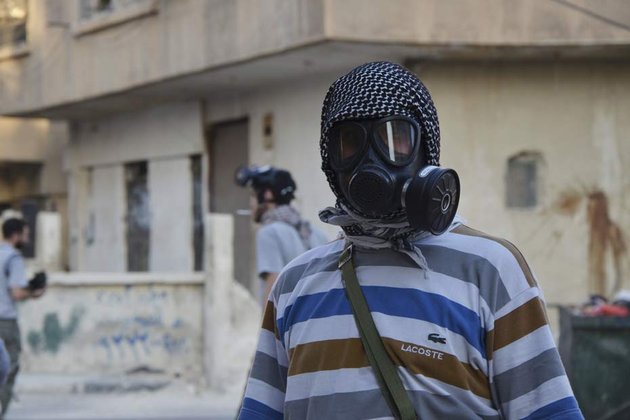
Regarding the infamous gas attack of 21. August in Damascus, I start being fed up by the lack of proficiency of the governmental public relations services and of the mass media. Therefore I will stick to the news in this post.

Firstly, I would like to clearly state that I don't negate that a gas attack has taken place on 21. August. I don't negate that hundreds of people have been killed. My only concern is the weakness of the arguments displayed to the citizens of our democracies so that they properly understand what has taken place and can then support their respective governments. This is how war becomes legitimate: when a democratic Nation unanimously decides to back its government when it has to enforce peace wherever it is.
Today, my only concern is the respect for the citizen.

2013-02-09

France in Mali: a military success and a strategic dead end

Usually I am a great fan of O. Kempf, the author of Egea, the must among the blogs dedicated to strategic studies, at least in French language. However, some days ago I was surprised by one of his articles, titled: "Mali, les permanences géopolitiques s'imposent...", that could be translated as: Mali, the standing geopolitical rules still prevail...".

What does then O. Kempf deal with?

2010-06-05

NATO: the impossible reform of the military capabilities

Thanks O. Kempf and his blog, I could get some insight in Mrs Albright’s report on NATO 2020. Well, the group of experts is really impressive, as they encourage the NATO to do all what it could not achieve in the past 20 years.

Depending on the time available I will try to demonstrate that the reform of the NATO that the group of experts is promoting will surely fail, or at least become reality not earlier than in 2040. When writing ‘reality’, I mean an effective ‘reality’, not the reality of the political statements. That is a different organization, with less headquarters, stronger defence forces within the European countries. In a way, a defence organization which gives our nations the tools to implement their policy.

Although the conclusions of the expert start like the homework of a college student (“the world has changed significantly since 1999”; for sure, it will be of great help to Mr Rasmussen), page after page it becomes more interesting.

For the time being, let us focus on the military capabilities. In a subsequent post, I will look at the political organization.

The main quote I will use is that one: “The primary limiting factor hindering military transformation has been the lack of European defence spending and investment.
Contributing to the problem is the fact that, in the past twenty years, European defence spending has been consumed disproportionally by personnel and operational costs. As a result, European national forces generally do not have nearly enough transformed forces.” (P. 38)

Indeed, I fully disagree with that belief that Europe does not spend enough on defence. In contrary, I support the statement that the money was and is not properly spent. Let us have a look at the defence expenditure of European Union countries (including the UK). Every year, the EU state members spend 200 billion Euros for their defence (Source: EDA). For what result? Out of 1.800.000 soldiers, a maximum of 80.000 is deployed. What the hell the other soldiers are doing all year long? Simply they guard borders that no enemy will cross within the next 20 years, because those very countries will not and will never accept to put down their armies, still largely inherited from Cold War time, and build up lean and expeditionary forces.

A good example is Poland: a few years ago, in 2002, they bought, with a strong US support, F-16. Against whom? Russia? Impossible, the same year, the NATO-Russia Council was set up. Since then, the Polish F-16 have not been deployed yet.

As well, I don not support at all the promotion of Research and Development that is expressed throughout the report: currently, only the USA would take profit out of it through programs like the Joint Strike Fighter, for which only a very few countries, mainly the UK can really get access to the most sensitive data.

Thirdly, regarding current needs in Afghanistan, the NATO asks regularly for more boots on the ground. Well, you do not need high-tech, Robocop style soldiers for those missions. You rather need well-trained troop, ready for patrolling in villages. The issue is that such soldiers do not match with the US technologic approach of military operations.

Therefore, the proposition for a greater effort in R & D or for more versatile and lean defence organizations is not the expression of an operational need. This is the expression of a US desire to see the European build a system, which fits to their own objective, including their industrial development, like in the F-16, the JSF and now the ballistic missile defence.

2010-04-02

Western European Union coming to its end. Was it really opportune?

On 31st March O. Kempf, wrote on his blog (here), that the WEU was coming to its end.
Of course, the author expressed his strong regrets and in his analysis assessed that this decision was not totally opportune.

I fully support his assessment, firstly because he is very competent in all geopolitical issues, secondly because the press statements of WEU member nations do not match.

As a first approach I do not see this as a major decision of our governments: most of the WEU had been already since a while handed over to the EU Council, as the Secretary General of the EU was double hatted SecGen of the WEU. Torrejon is the best example of this transfer of authority. The only remains of the WEU was the parliamentary assembly, renamed lately ESDA.

1. Statement of the French Government (here)
France and its partners have decided to withdraw from the WEU as a consequence of the Lisbon Treaty and the progress of the European construction, as the EU has taken over all the functions of WEU.

2. Statement of the German Government (here)
The German federal cabinet has decided to withdraw from the WEU. Continuing with the WEU would create duplication with the EU structures. Dissolving the WEU means that the place to discuss about European security is the EU.

3. Statement of the Spanish Government (here)
Firstly Spain speaks on behalf of all the contracting parties.
NATO and the Lisbon Treaty are the basis for collective defence. Spain will make sure that the discussions between the national Parliaments will go on, based on the protocol n°1 of the Lisbon Treaty.
I suppose that the Spanish Government refers to the article 9 (page 203 of the Lisbon Treaty).

4. Statement of the British Government (here)
The WEU role was essentially symbolic referring to collective defence. The current work of the parliamentary assembly is not the cost of 2 millions Euros a year for UK alone worth. And the most important: “Given the inter-governmental nature of CSDP, we believe, however, that this remains fundamentally a matter for national parliaments. There is no reason and no case for the European Parliament to expand its competence in this area”.

An easy conclusion is that Germany has a very federalist approach, while the UK relies on the inter-governmental relations, agreeing with Spain, only on the role of the NATO, while France and Germany simply ignore it.

Obviously the role of forum that the Parliamentary Assembly of the WEU was playing was not that stupid, as it could help our nations getting a common approach on defence matters. Indeed, for the time being, the European Parliament, in accordance with the Lisbon Treaty plays no role in the issue as Defence and its budgets (of course) remain purely in the national field of competence.

Therefore, I join O. Kempf: we know what we loose, not what we gain. Having met Robert Walter several times, I really think that he will strive maintaining an inter-governmental parliamentary structure. Isn’t he a UK –conservative member of the House of Commons? In any case, the UK will never (at least in the next decade) support the German federalist approach.